
THEATER FOR THE NEW CITY
Executive Director, Crystal Field, with
The LES Committee, Presents:
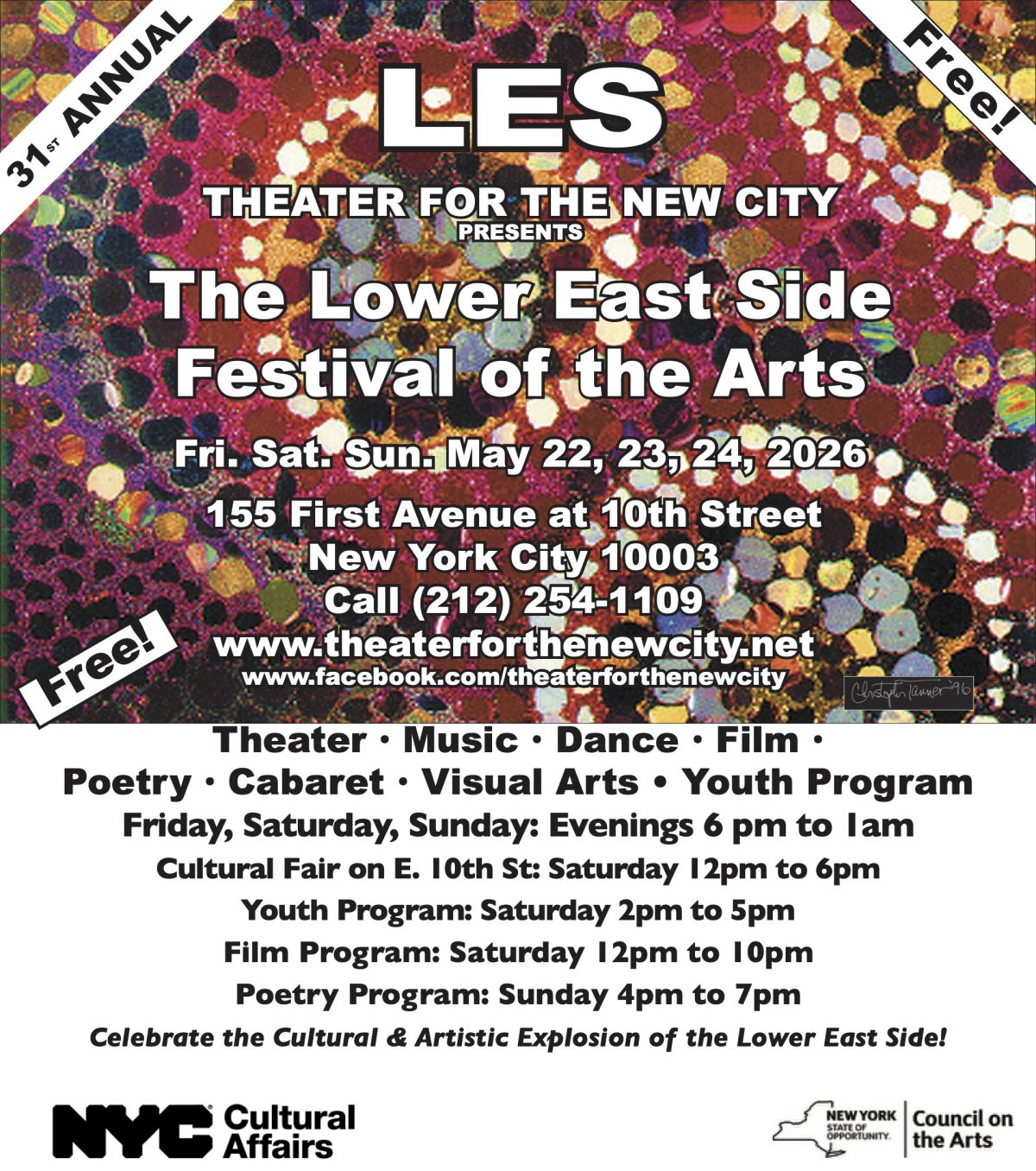
The 31st Annual LOWER EAST SIDE FESTIVAL OF THE ARTS
FREE!!!
Memorial Day Weekend
MAY 22, 23, 24, 2026 – Friday, Saturday, Sunday
THEATER FOR THE NEW CITY
155 First Avenue (btw E 9th and E 10th Street)
New York, NY 10003
212-254-1109
Directions
Listen to our LES promo on 1010 WINS!
Theater for the New City has currently scheduled over 200 performing arts organizations, independent artists, poets, puppeteers and film makers for its 30th annual Lower East Side Festival of the Arts.
Admission is free but donations will be gratefully accepted.
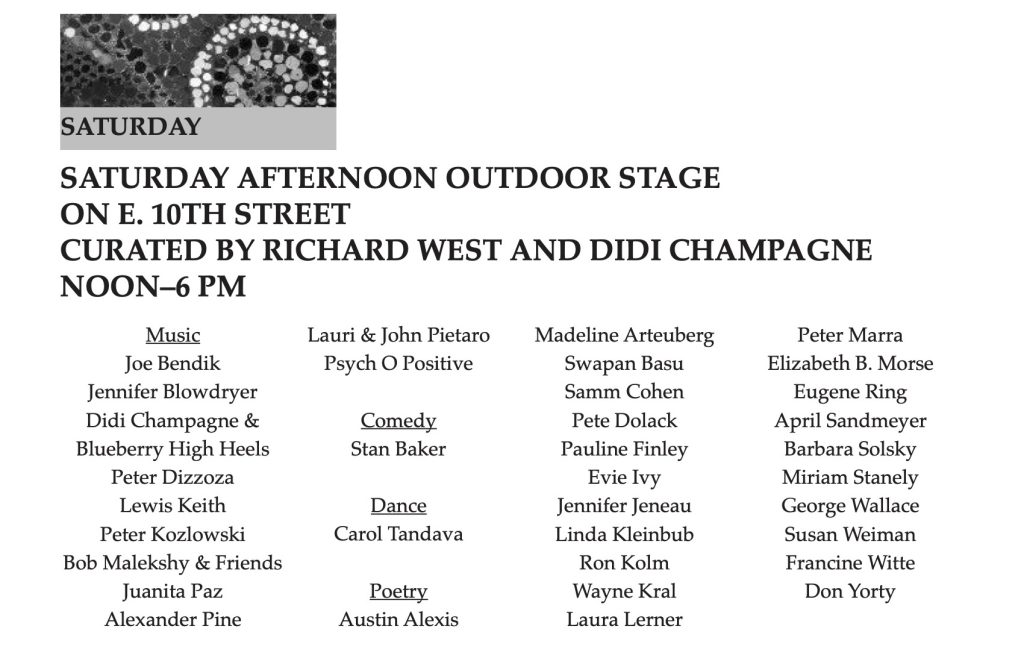
Indoor performances will take stage from 6:00 PM to midnight each day, utilizing two of TNC’s four theaters. From 10:00 AM to 6:00 PM Saturday, vendors and food sellers, including booths from nearby restaurants, will set up in the closed-off block of East Tenth Street between First and Second Avenues.
The festival has been presented annually since 1996, with a cohort of theater, dance, performance, music, film, literary and visual artists participating on all three days. This year, the festival is mounted with the theme “Courage Through the Arts: A Vote Against Tyranny.” The subject will be addressed in some of the playlets and acts written for the festival.
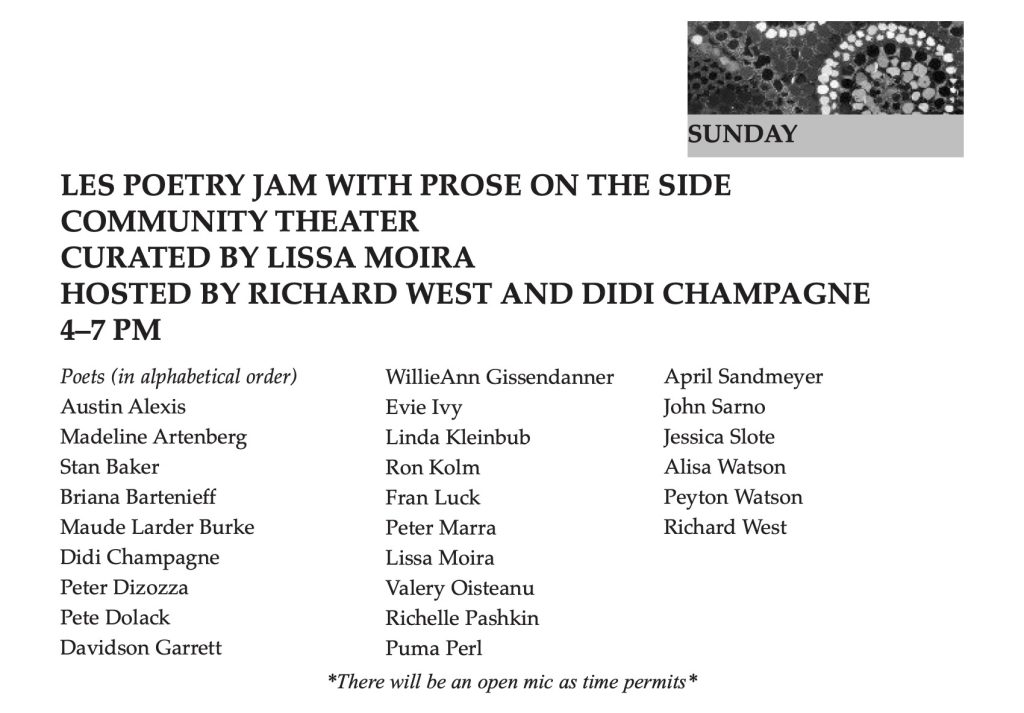
Multidisciplinary indoor performances will take stage from 6:00 PM to midnight each evening, utilizing two of TNC’s four theaters. From 10:00 AM to 5:00 PM Saturday, vendors and food sellers, including booths from nearby restaurants, will line the closed-off block of East Tenth Street between First and Second Avenues. On Saturday afternoon inside in the Johnson Theater, there will be performances by and for children, curated by T. Scott Lilly, Danielle Hauser and Miguel Loyola, emceed by John Grimaldi. A fine art show, curated by Carolyn Ratcliffe, will be displayed throughout the fest in the theater’s lobby gallery. A film program will be presented Saturday from noon to 10:00 PM in the Cabaret Theater, featuring works by auteurs from the Lower East Side/East Village along with works that reflect the essence of the neighborhood. Over 20 films curated by Burak Tatar will be screened, accompanied by talkbacks with a number of the film makers. On Saturday from 1:00 PM to 5:00 PM, an Outdoor Stage adjoining the theater will offer music and multi-discipline performances curated by Richard West, assisted by Didi Champagne. On Sunday from 4:00 PM to 7:00 PM in TNC’s Community Theater, there will be a “Poetry Jam with Prose on the Side” curated by Lissa Moira and emceed by Richard West and Didi Champagne.
The performers’ roster includes such luminary performers as David Amram and Penny Arcade. Manhattan Borough President Brad Hoylman-Sigal and NY City Council Member Gale A. Brewer (6th District) will address the gathering on Saturday, May 23 at 8:00 PM.
Performing ensembles participating will include Bond Street Theater, Chinese Theatre Works, Cobu, The Drilling Company, Folksbiene National Yiddish Theater, Kinding Sindaw, New Yiddish Rep, Textile Theater Collective, Wise Guise, and many more.
There will be original writings (many penned exclusively for the festival) by Anne Lucas, Barbara Kahn, Douglas Lackey, Elizabeth Ruf, Larry Littany Litt, Miguel Loyola, Toby Armour, Tom Diriwachter, Stefan Diethelm, Briana Bartenieff and Victor Vauban Jr.
Excerpts of plays performed will include “Tortas Y Tacones” by JC Augustin (an excerpt of his “Detonation Rat Cabaret”), “Dana II” by Jasmine Hyman, projects of Mary Tierney’s TNC Theater Workshop, “Decay of a Rose” by Victor Vauban, and songs from TNC’s 2025 Street Theater production, “Home Sweet Home, or a Life In New York.”
Individual performers appearing will include Glitter Kitty (Emily Vetch and Jeff Davis), John Grimaldi, Stan Baker, Terry Lee King (Amazin’ Grace), Tym Moss, Zero Boy, David F. Slone Esq. and Ed Malin.
Dance performances will include works by Ashley Liang Dance Company, Carol Tandava, Rastro Dance Company (Julieta Valero), Rod Rodgers Dance Company, Thunderbird American Indian Dancers and aerial dance by Constellation Moving Co.
Musical performers appearing will include Alessandra Belloni, Art Lillard Quartet, David Amram, Joe Bendik, Louisa Bradshaw, Michael A Green, Mimi Block, Mister Pablo, Noam Fainegold’s Burning City Orchestra, Peter Dizozza, Richard West, Robert Gonzales Jr. and Yip Harburg Rainbow Troupe.
Comedy performers will include Joan Reinmuth, Fei Lin Yang and others TBA.
“Poetry Jam with Prose on the Side,” curated by Lissa Moira and hosted by Richard West and Didi Champagne, will take stage Sunday, May 24 from 4-7pm in TNC’s Community Space Theater. Wordslingers are TBA. An open mic will follow as time permits.
This year, the film program, curated by Barak Tatar, is screening over 20 projects, shorts, documentaries, and animations, all projects created by New York Artists or shot in New York, particularly emphasizing LES Artists. Talk backs follow each screening. (Saturday from noon to 10:00 PM.)
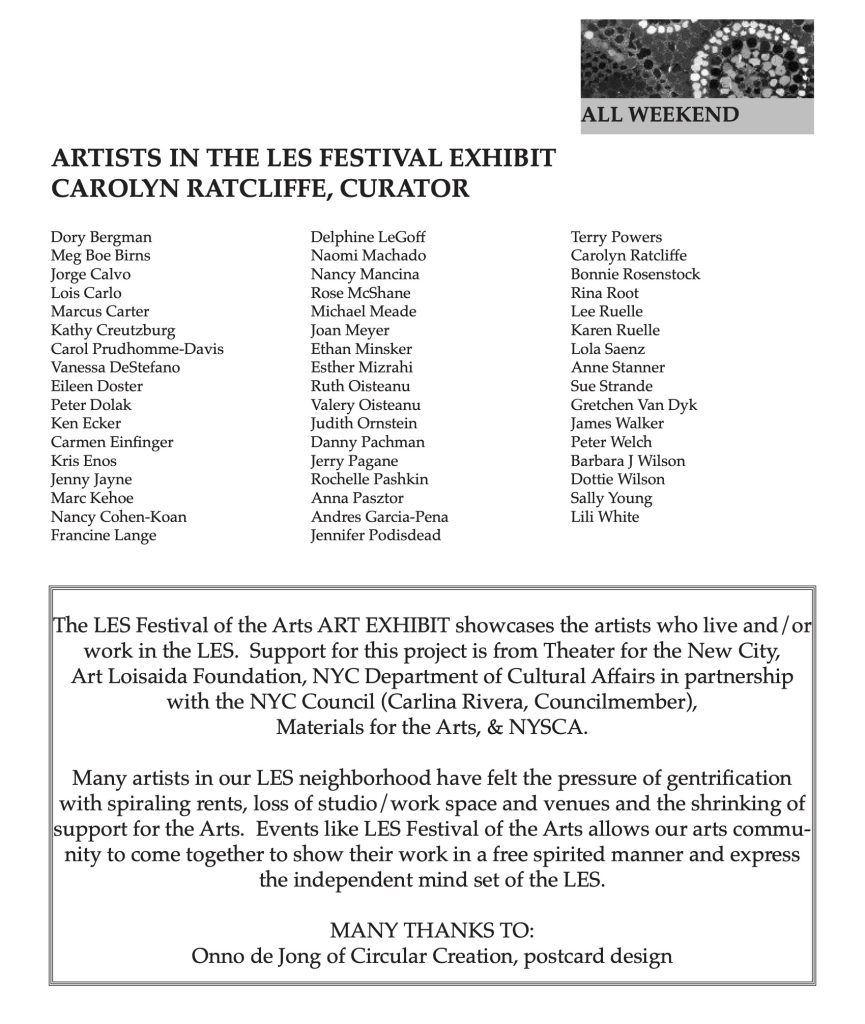
Throughout the festival, an art show curated by Carolyn Ratcliffe will grace the TNC lobby spaces. This exhibition will have its own free, special opening Wednesday, May 21 from 5:30 PM to 8:00 PM. Participating artists are TBA.
In the Johnson Theater, emcees will be Crystal Field, Robert Gonzales Jr., Danielle Aziza, Melanie Goodreaux and Sabura Rashid. In the Cabaret Theater, emcees will be Tim Moss, Elizabeth Ruf and Wendy Stuart. The film program will be emceed by Burak Tatar.
Specialty curators of the festival include Lissa Moira (poetry), Burak Tatar (film), T. Scott Lilly and Danielle Hauser (kids’ performances), Carolyn Ratcliffe (visual art) and Richard West and Didi Champagne (outdoor theater-dance-music). The whole festival is organized by the LES Committee (see below) and chaired by Crystal Field.
Lower East Side Festival of the Arts Exhibit
LES: COURAGE IN THE ARTS: A VOTE AGAINST TYRANNY
SCHEDULE IS SUBJECT TO CHANGE
FRIDAY EVENING IN THE JOHNSON – MAY 22
6:00 – Cobu
6:22 – Artichoke Dance Company
6:34 – Penny Arcade
6:46 – Peter Dizzoza
6:58 – Briana Bartenieff
7:10 – The Rainbow Troupe
7:22 – Alison Cook Beatty (Dance)
7:34 – Tym Moss
7:46 – Julieta Valero
7:56 – Sylvian Laroux
8:08 – Drilling Company
8:20 – Thunderbird (Louis)*
8:32 – Melange
8:44 – Bradshaw/Nissen
8:56 – Glitter Kitty
9:08 – Street Theater Company
9:20 – Mister Pablo
9:32 – Inma Heredia
9:44 – Street Theater
9:56 – WilliAnn Gissendamer
10:08 – The Wise Guise
10:20 – Amy Coleman
10:32 – Miguel Loyola
10:44 – Nathan Fosbinder
10:56 – Zen Mansley
11:08 – Gravity
11:20 – Steve Epstein
11:32 – Rocco George
11:44 – Terry Lee King and Billy Little
FRIDAY EVENING IN THE CABARET – MAY 22
6:30 – Star ’69
6:52 – Leila Wright
7:04 – David Jacobson
7:16 – Anwar Suleiman
7:28 – Sheila Walsh
7:40 – Textile Theater Collective
7:52 – Wendy Stuart
8:04 – Evan Laurence
8:16 – Jason Carmichael
8:28 – Stefan Diethelm
8:40 – Viktoriya Papayan
8:52 – Lei Zhou
9:04 – Larry Litt
9:16 – Robert Greer
9:28 – Stan Baker
9:40 – Fei Lin Yang
9:52 – Lady Clover Honey
10:04 – Jasmine Hyman
10:16 – The Tierney Workshop
10:28 – Rew Star
10:40 – Mariposa Hernandez
SATURDAY AFTERNOON YOUTH PERFORMANCES
JOHNSON THEATER
Coordinators: Danielle Aziza & T. Scott Lilly
Hosted by John Grimaldi
2-5 PM
2:15 PM – THE ZYLIK BROTHERS
2:30 PM – MARTIAL ARTS FAMILY STUDIO
2:45 PM – ROCK BANDS FOR KIDS
3:00 PM – TNC ARTS IN EDUCATION
3:30 PM – COBU “NEXT GENERATION”
3:45 PM – MOVE. MAKE. BLOOM
4:00 PM – PS 166 AMAZING ATHLETE’S CIRCUS
4:15 PM – THE YIP HARBURG RAINBOW TROUPE
4:30 PM – FAIRY TALE MARIONETTES
SATURDAY FILM PROGRAM 12 PM – 11 PM
The Cabaret Theater (downstairs) seats about 65
Curator: Burak Tatar
Technical Director: Roy Chang
Hosted by Burak Tatar and Erdem Erdal Ülker
Q&A After each block.
Download for full descriptions here:
FILM PROGRAM SCHEDULE
SATURDAY EVENING IN THE JOHNSON – MAY 23
6:00 – Mimi (Mother: Tomoko) Block
6:26 – John Grimaldi
6:38 – Douglas Lackey
6:50 – Varshini Krishnaswamy (India Center Dancer)
7:02 – Yara Arts Virlana Tkacz Yara Arts
7:14 – Lynnea (from Estelle) Benson
7:26 – Victor Vauban
7:38 – Zylik
7:50 – Shran (Sitar player)
8:00 – Gale Brewer
8:06 – Brad Hoylman
8:14 – Ashley Liang
8:36 – Carol Tandava
8:48 – Judy Gorman
9:00 – Chinese Theatre Works
9:12 – David Mandelbaum Folksbiene
9:24 – Sharif Bina
9:36 – Dunesical
9:58 – David Amram
10:20 – KT Sullivan
10:32 – Ellen Stier
10:44 – The Croquet player 1
10:56 – Robert Gonzalez
11:08 – The Croquet player 2
11:20 – Yenny Sanchez
11:32 – Toby Armour
11:46 – Lenin Alivante
SUNDAY EVENING IN THE JOHNSON – MAY 24
6:00 – Art Lillard Quartet
6:32 – Queer Big Apple Corps
6:44 – Susan MacEuan
6:56 – Riki Rose
7:08 – Tom Diriwatcher
7:20 – constellation moving company
7:32 – Zero Boy
7:44 – Anni Rossi
7:56 – Barbara Kahn
8:08 – Perri Sussman
8:20 – Richard West
8:32 – Alessandra Belloni
8:44 – Kinding Sindaw
8:56 – Caytha Jentis
9:18 – Melanie Godreaux
9:30 – Toni Renee Taylor
9:42 – Bennet Pologe
9:54 – Sarah Jamane Lily
10:06 – Tango Dance Works
10:18 – JC Detonation/What’s Tomorrow
10:30 – Elissa Blynn
10:42 – Asher Cohen
10:54 – Jose Ruiz
11:06 – Arley Trice
11:18 – Michael Christian
11:30 – Valery Oisteanu
11:42 – Darling Toby
11:54 – Doug Principato
12:06 – David Slone
SUNDAY EVENING IN THE CABARET – MAY 24
6:30 – Noem Feingold
6:52 – Matthew Moore
7:04 – Richard Weber
7:16 – J. Dolan Byrnes
7:28 – Lower East Side Performing Arts
7:40 – Darpin Joshi
7:52 – Samantha Mileski
8:04 – Burak Tatar
8:16 – India Stachyra
8:28 – Stephanie Vesina
8:40 – Beth Griffith
8:52 – Dante Jayce
9:04 – Joe Bendik
9:16 – Elizabeth Ruf
9:28 – Emilio Garcia
9:40 – Ed Malin
BACKGROUND
The first festival, presented June 14 to 16, 1996, was a three-day, indoor and outdoor multi-arts festival, organized by TNC and a coalition of civic, cultural and business leaders. The aim was to demonstrate the creative explosion of the Lower East Side and the area’s importance to culture and tourism for New York City. It employed two theater spaces at TNC plus the block of East Tenth Street between First and Second Avenues, featured over 100 attractions, drew favorable press and attracted crowds from all around the City. Its success prompted TNC to continue the festival annually on Memorial Day Weekend. For 28 years it has been presented free each year to an average attendance of 4,000. (In 2020 it was held online due to pandemic concerns).
The concept of the festival was developed by Crystal Field, Executive Artistic Director of TNC and Esther Cartegena (d. 2006), President of Loisaida, Inc., to portray the Lower East Side (LES) as a haven for artists and artistic creation. The region is a unique multi-ethnic community with an unusually high level of artistic vitality. Large populations with differing languages and cultures coexist there successfully and a large artistic population helps glue the neighborhood together. Its theaters are also an unprecedented source of tourism. Sam Shepard’s Pulitzer Prize-winning play, “Buried Child,” was commissioned and first produced by TNC. The committee envisioned an event that would demonstrate the region’s cultural fervor, its large artistic population and its multiplicity of ethnic influences to contradict the neighborhood’s stereotype as a dangerous refuge for drug dealers and criminal activity.
Disciplines presented have always included theater, music, dance, poetry, puppetry, cabaret, visual art, film and children’s programming.